
Multi-Agent System Design for Enterprise Workflows: When to Use Orchestration vs Delegation
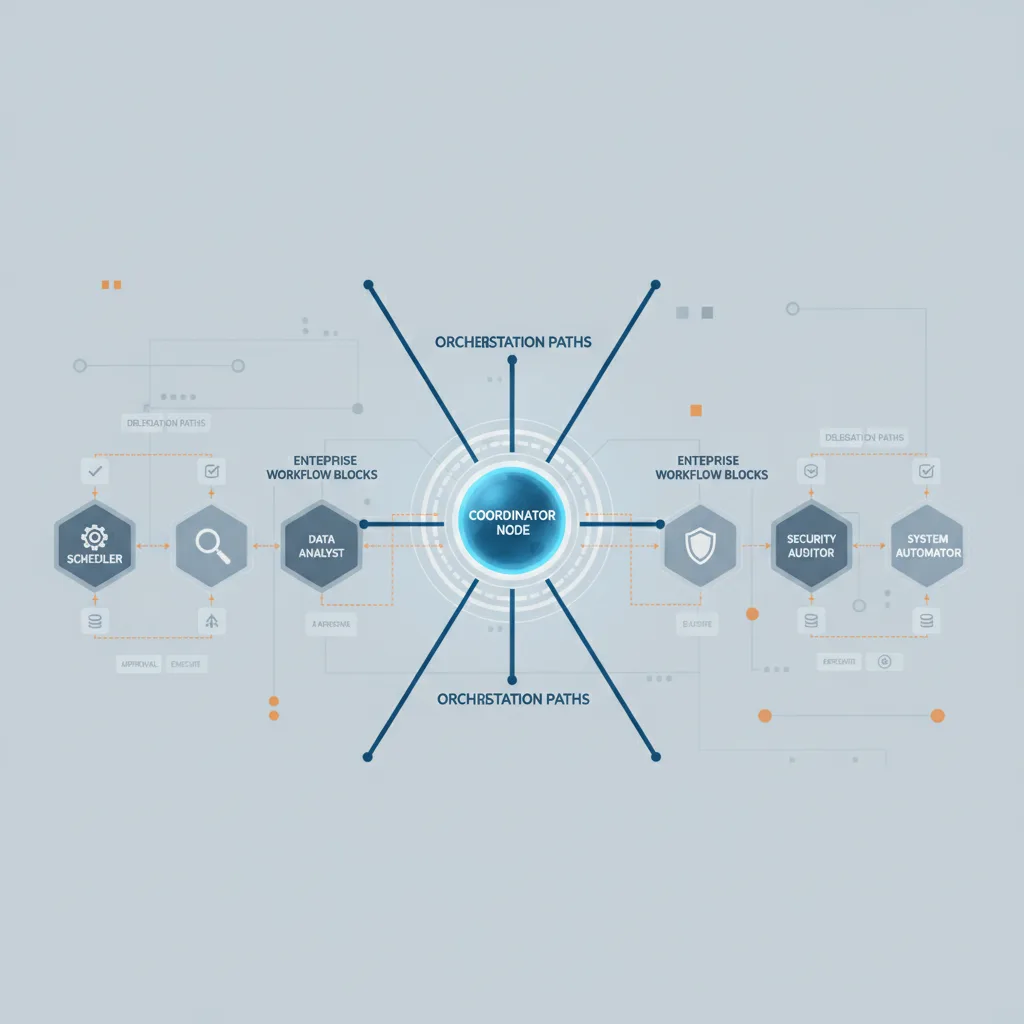 bicaralabs · MULTI-AGENT SYSTEM DESIGN FOR ENTERPRISE WORKFLOWS
Designing a multi-agent system for enterprise workflows is not about adding more agents. What matters more is choosing the right control pattern. The two patterns that come up most often are orchestration and delegation. Both can work. Both can also fail once they reach a production system.
When this decision is wrong from the start, the symptoms tend to look the same: agents bounce tasks between each other, tools get used outside their limits, hidden state becomes hard to trace, and prompts turn into patches for architectural problems. That is why the choice between orchestration and delegation should be treated as a system decision, not a prompt decision.
This article covers when each pattern is worth using, the failure modes that commonly show up in production, and practical patterns for routing, memory, tool access, evals, and governance before a system ships to client infrastructure.
Orchestration vs delegation in multi-agent systems
Put simply, orchestration means one coordinator agent or service layer holds primary control. It receives the objective, breaks the work down, picks the relevant specialist agents, and combines their results. The main flow is explicit. State is easier to observe. Guardrails are easier to place at a single point of control.
Delegation, by contrast, gives agents more autonomy. One agent can decide to hand a subtask to another agent based on the context it sees. This pattern is more flexible for work that cannot be fully mapped up front, especially when subtasks are dynamic or branch out.
When should you use orchestration?
- When the steps of the enterprise workflow are already reasonably clear.
- When compliance, auditability, and control over tool access are priorities.
- When output must be consistent across cases.
- When you need to know who did what, with which input, and what decision was made.
When should you use delegation?
- When the problem space is more open and not every subtask can be predicted up front.
- When specialist agents have clear domain roles and can safely make local decisions.
- When the extra latency of a coordinator is acceptable, or when reducing manual handoffs actually produces better results.
In enterprise practice, the safest pattern is rarely purely one or the other. The more common choice is bounded delegation: the coordinator keeps control of the objective, policy, and tool-access limits, while specialist agents may delegate specific subtasks within a space that has already been constrained.
The failure modes that show up in production
In a demo, many multi-agent systems look tidy. In production, the problems appear quickly.
1. Loops and endless handoffs
Agent A sends to Agent B. Agent B decides it lacks context and throws the task back to Agent A, or to Agent C, which eventually sends it back again. Without a firm termination condition, the system burns tokens and time without improving the result.
2. Tool misuse
An agent is given too many tools and starts picking the wrong one, because tool descriptions are ambiguous or the objective is not narrow enough. In enterprise workflows this is dangerous. A tool is not just an extra capability; it is a risk surface.
3. Hidden state
Important decisions live in conversation memory, unversioned prompts, or intermediate context that is not recorded properly. When a result is wrong, the engineering team struggles to answer basic questions: what state did the agent read, who changed it, and when?
4. Brittle prompts
Weak architecture is often covered up with ever-longer prompts. The results look good on a few examples, then collapse as input variety grows. Prompts matter, but a prompt must not replace the contract between components.
5. Unclear ownership
If every agent can route, validate, and execute tools at the same time, no single point is truly responsible for the quality of the final result. When an incident happens, there is observability but no accountability.
That is why a multi-agent system fit to ship to a client must be designed for traceability from the start, not have it bolted on later.
A practical pattern for routing, memory, and tool access
The most practical pattern for many enterprise workflows separates the system into four layers:
1. Router or coordinator
This component receives the objective, reads the policy, and decides the execution path. It does not need to be the “smartest” agent. Its job is to keep the flow disciplined.
2. Specialist agents
Each agent has a narrow domain: for example extraction, classification, drafting, validation, or exception handling. The clearer the contract, the lower the risk of prompt bleed and tool misuse.
3. Tool gateway
Do not let every agent talk directly to every tool. Wrap tools in an access layer that logs requests, enforces permissions, and validates inputs and outputs. This matters for governance.
4. State and memory layer
Separate working memory, task state, and long-term context. Not everything belongs in conversational memory. Keep only the context that is really needed, with an explicit schema.
A few design rules that usually help:
- Use structured handoffs, not just natural-language handoffs. Each agent should receive a clear objective, input schema, decision boundary, and expected output.
- Limit tools per agent. Fewer tools usually means more stable decisions.
- Define stop conditions on every branch. If confidence is low or data is incomplete, escalate to a fallback path instead of delegating further.
- Separate reasoning from action as far as possible. Not every piece of reasoning needs to become an action that touches an external system.
- Record the important intermediate artifacts. Summaries, classifications, and routing decisions should be stored as auditable state.
With this pattern, delegation can still be used, but inside clear fences. That usually suits production needs better than full freedom between agents.
What to evaluate before shipping to client infra
Evals are not a research extra. Evals are a condition for shipping. Without evals, the team only knows the system looks good on a few examples. That is not enough for an enterprise workflow.
Before deploying to client infrastructure, evaluate at least the following:
Task success
Does the system complete the objective correctly in normal scenarios and in the edge cases you have defined?
Routing quality
Does the coordinator pick the right agent? Does delegation happen only when it is actually needed?
Tool correctness
Are the tools called appropriate to the context? Are tool inputs valid? Are tool outputs handled correctly?
Termination behavior
Are loops detected? Are there retry limits, an escalation path, and a consistent fallback?
State integrity
Is the memory carried between steps actually relevant? Is any state leaking, duplicated, or out of sync?
Governance and policy adherence
Do agents respect access limits, approval rules, and logging requirements?
In a client environment, model quality alone is not enough. What gets judged is the behavior of the whole system. That is why evaluation must cover workflow, tooling, state, and policy together.
Where multi-agent systems fit, and where they do not
A multi-agent system fits when the problem really consists of several distinct roles, subtasks need coordinating, and the business value comes from a workflow that runs continuously rather than from a single prompt.
For example, such a system makes sense when routing, validation, extraction, drafting, and decision support are combined in one workflow that must be observable and controllable.
But not every problem needs multiple agents. If one agent with a limited set of tools is enough, do not split the system too early. Adding agents means adding handoffs, state, observability surface, and failure areas. Complexity is only worth paying for when it buys better control or quality.
The practical rule is simple: start with the smallest architecture you can audit. Add a specialist agent only when there is a clear reason, such as the need to isolate a role, different tool access, or routing that is genuinely awkward to handle in one component.
For enterprise teams, the right question is not “can we build many agents?” but “which control structure makes this workflow safe, auditable, and actually shippable to production?”
If the answer demands tight control, choose orchestration. If it demands local flexibility within clear limits, use bounded delegation. Most importantly, do not stop at the concept. Systems like this have to be built, tested, deployed, and then tuned in a real environment.
Conclusion
Multi-agent system design for enterprise workflows is an engineering decision. Orchestration gives control, auditability, and consistency. Delegation gives flexibility, but it must be bounded by contracts, a state model, and clear tool governance. In production, the winner is not the pattern that looks most impressive in a demo. It is the pattern that stays stable when it meets real workflows.
If your team is designing an AI agent or enterprise workflow that has to run in client infrastructure, talk to Bicara Labs for a 30-minute scoping call. We build AI systems that are ready for production, from design to deployment, not just advice.